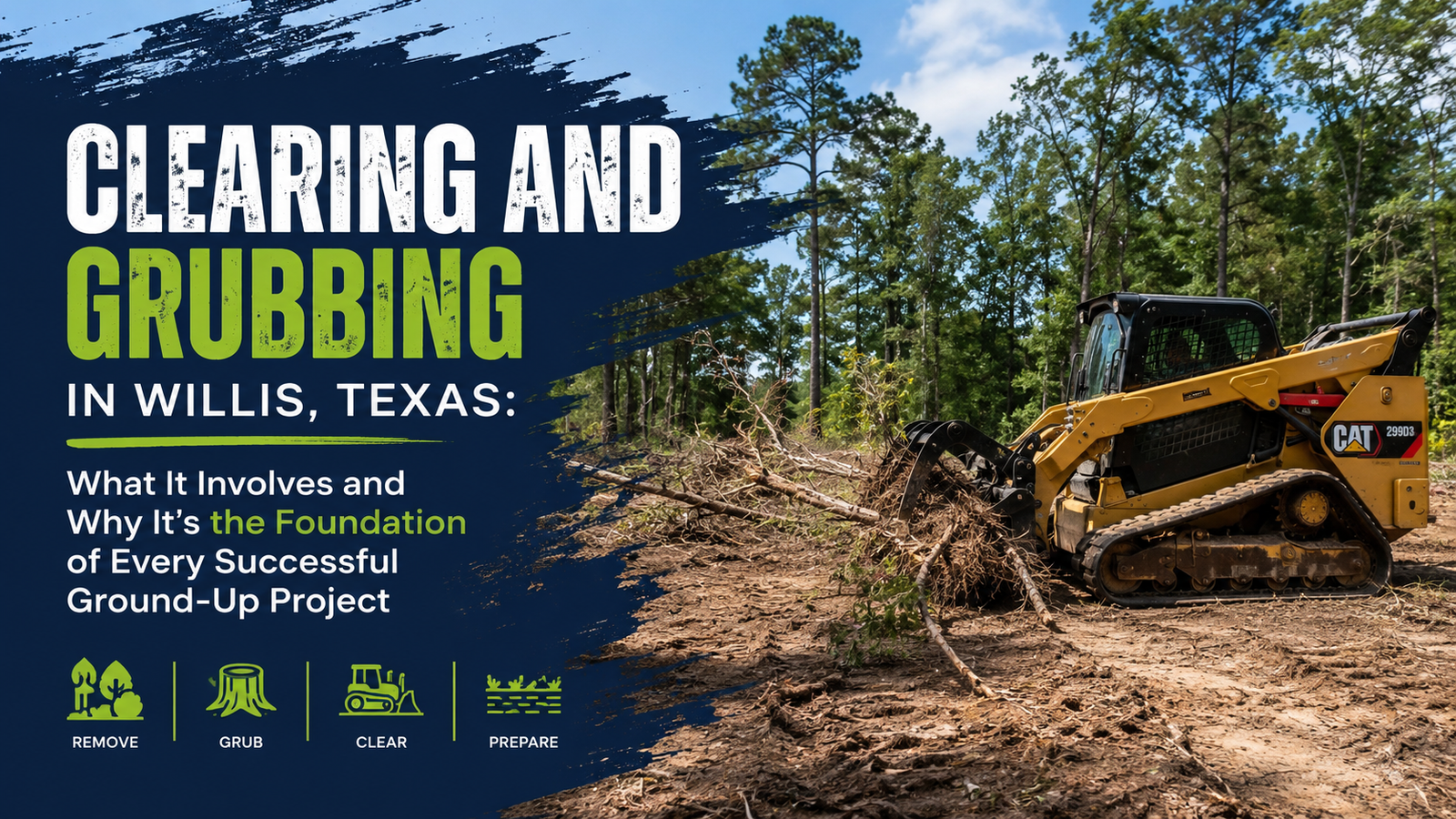
Of all the site preparation services performed on Willis, Texas properties, Clearing and Grubbing Willis is the one most often misunderstood and most often performed incompletely by contractors who do not fully appreciate what the terms require or why it matters for the long-term performance of whatever is built on the cleared ground. In construction and civil engineering, clearing and grubbing refers specifically to the combined process of removing all above-ground vegetation (clearing) and then removing the subsurface root masses, stumps, and organic material from the soil profile (grubbing). Both steps are essential, but grubbing the underground component is the one most frequently shortchanged, and the consequences of incomplete grubbing show up years later as foundation settlement, drainage problems, and subsurface voids that undermine the investment made in whatever structure or improvement was built on top.
Clearing: The Above-Ground Phase
The clearing phase of clearing and grubbing encompasses the removal of all standing vegetation from the designated project area. In Willis and the surrounding Montgomery County area, this typically means removing mature loblolly pines and hardwoods, dense yaupon holly thickets, brush, native grasses, briars, and any other above-ground plant material within the clearing boundary. Existing structures, fences, or debris within the clearing footprint are also addressed during this phase.
The methods and equipment used for clearing in Willis depend on the density and character of the vegetation. Forestry mulching using tracked machines with high-speed rotating drum heads is the most efficient single-pass approach for brush and trees up to approximately 6 to 10 inches in diameter, processing vegetation into mulch in place without requiring debris hauling. For larger trees, chainsaw crews fell the trees, and excavators or bulldozers process and move the material. Where burn permits are available in the rural Willis area, combustible material can be burned on site, significantly reducing hauling requirements and project cost.
The spatial extent of clearing must be carefully defined before work begins. In construction projects, the clearing boundary is typically the area required for the building footprint, foundation excavation, access drives, utility corridors, and any grading work plus a safety margin around each of these elements. Clearing beyond what is operationally necessary removes trees that have no functional benefit to remove and that represent value shade, character, wildlife habitat, and visual appeal once the construction is complete. A thoughtful pre-clearing site assessment that marks trees to be preserved and establishes the clearing boundary is one of the most valuable steps a Willis property owner can take before a clearing crew arrives.
Grubbing: The Underground Phase That Makes the Difference
Grubbing is the excavation and removal of stumps, root masses, and the organic-rich upper soil layer from the construction zone after clearing has been completed. It is the step that is often minimized stumps are ground flush with the surface, or buried rather than removed, or roots are left in the soil profile and the step whose absence is most clearly felt years later.
The reason grubbing matters so profoundly for construction projects comes down to the behavior of organic material in the soil. Wood whether in the form of stumps, root masses, or buried logs decomposes in the soil over time. As it decomposes, it loses volume, creating voids. Those voids, when they form beneath a foundation, pavement, or other structure, create differential settlement the structure above settles unevenly as the organic material beneath it disappears. Differential settlement is one of the most common and expensive causes of structural damage to buildings, and its connection to inadequate grubbing during site preparation is well-established.
In Willis and Montgomery County, the loblolly pine root systems that are ubiquitous on wooded properties present a specific grubbing challenge. Loblolly pine develops a substantial taproot system that can extend several feet below the surface, combined with lateral roots that spread well beyond the trunk diameter. A stump that is ground to grade level still has its root mass extending underground roots that can extend 10 to 20 feet or more from the tree location and that will decompose over years and decades, slowly creating voids in the soil profile. For construction on former pine timberland, thorough grubbing of the footprint is not optional if foundation performance is to be protected.
Grubbing is performed using excavators that dig to the specified depth below the clearing zone, extracting root masses and organic material and loading them into trucks for disposal or into piles for burning. The depth of grubbing required depends on the planned end use. For areas that will be graded and surfaced with aggregate or pavement, grubbing to a depth of 12 to 18 inches below finished grade is typically specified. For areas where foundation construction will occur, geotechnical engineers may specify greater grubbing depths depending on the density of root material and the design requirements of the foundation system.
The organic-rich topsoil layer stripped during grubbing has agronomic value and should be stockpiled separately from subsoil and mineral fill. This “topsoil” dark, humus-rich material from the upper soil profile can be redistributed to landscape areas, garden beds, or lawn zones after construction is complete, where it provides a superior growing medium compared to the clay or sandy subsoil that is typically exposed after grading.
Texas Regulatory Requirements for Clearing and Grubbing
Clearing and grubbing operations in Willis involve regulatory considerations that responsible contractors and property owners must address before work begins. Texas 811 notification the state’s one-call underground utility location service must be contacted at least two business days before any excavation or grubbing begins. The notification triggers marking of registered underground utilities in the project area, preventing the potentially dangerous and costly accidental strike of buried gas, water, electrical, and telecommunications lines during grubbing operations.
TCEQ’s Construction General Permit requirements apply to clearing and grubbing projects that disturb one acre or more of land in Texas. These projects must have a Stormwater Pollution Prevention Plan (SWPPP) in place before disturbance begins, covering erosion control measures, stormwater management, and material disposal practices. Montgomery County’s stormwater regulations may have additional requirements beyond the state TCEQ permit for projects within designated drainage management areas.
The disposal of cleared and grubbed material must be handled appropriately. Large quantities of wood from clearing operations can sometimes be sold as timber or biomass, burned on site where burn permits allow (common in the rural Willis area), chipped for mulch, or hauled to permitted disposal or biomass processing facilities. Root masses and grubbed organic material are typically burned or hauled, as they are too contaminated with soil to have biomass value and too bulky to chip efficiently. The disposal plan should be established before clearing begins to ensure the project can flow continuously without delays caused by unexpected material volume.
Clearing and Grubbing for Different End Uses in Willis
The appropriate scope and depth of clearing and grubbing in Willis depends significantly on what the cleared land will be used for. Different end uses require different outcomes from the clearing and grubbing process.
New home construction requires the most thorough clearing and grubbing of any common Willis land use. The building footprint, foundation perimeter, driveway pad, utility corridors, and the area within approximately 10 to 15 feet of the building must be cleared and grubbed thoroughly to protect the foundation from organic decomposition-related settlement. Septic drain field areas require particular attention grubbing equipment operating over planned drain fields compacts the soil, reducing its percolation capacity. Drain field areas should be cleared as minimally as possible, with heavy equipment excluded from those zones.
Commercial construction and site development require the same thorough clearing and grubbing as residential construction, scaled to the larger footprint and higher structural loading of commercial facilities. The pavement areas, building foundations, and drainage infrastructure of commercial sites all require clean, organic-free subgrade that only thorough grubbing provides.
Pasture establishment does not require grubbing to the depth necessary for construction, but it does require removal of stumps and large root masses that would interfere with mowing equipment and pasture management. Smaller roots left in the soil profile are less problematic in a pasture context than in a construction context, as they will eventually decompose without creating structural problems.
Common Questions About Clearing and Grubbing in Willis
What is the difference between clearing and grubbing, and do I need both? Clearing removes above-ground vegetation. Grubbing removes below-ground organic material stumps, roots, and the organic topsoil layer. For construction projects in Willis, both are required. Clearing without grubbing leaves a significant amount of decomposable organic material in the subgrade that will create foundation settlement problems over time. For non-construction uses like pasture or recreation areas, grubbing requirements are less stringent.
How deep does grubbing need to go for a house foundation in Willis? Geotechnical engineers specify grubbing depth based on site-specific conditions, but a common specification for residential construction in East Texas is removal of all organic material and root masses to a depth of 12 to 18 inches below the planned finished grade within the building footprint and foundation perimeter. Deeper grubbing may be required in areas with particularly deep root penetration or dense organic material.
Can cleared and grubbed material be burned on site in Willis, Texas? Yes, in many cases. Burning permits for land clearing debris are available through the Texas Forest Service for properties in rural Montgomery County outside fire bans. The availability of burning depends on current fire weather conditions burn bans during dry periods prevent on-site burning regardless of permit status. Your clearing contractor can advise on current conditions and the permit process for your specific location.